Retro Christmas Digital Paper: A Comprehensive Evaluation for Creative Projects
In the landscape of digital design and crafting, Retro Christmas Digital Paper has emerged as a versatile asset for individuals seeking to incorporate vintage aesthetics into their holiday projects. This collection typically features nostalgic patterns, warm color palettes, and classic motifs reminiscent of mid-20th-century holiday imagery. For designers, scrapbookers, and DIY enthusiasts, understanding the specific capabilities and limitations of these files is essential before integrating them into professional or personal workflows.
Understanding the Product Specifications
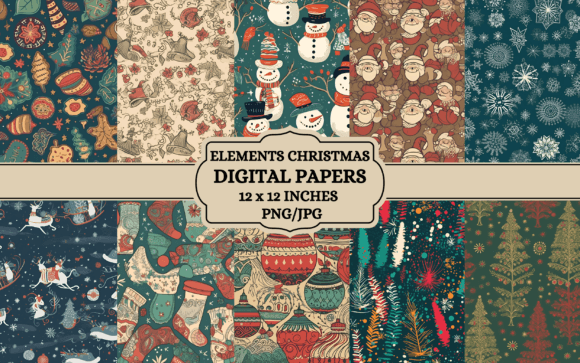
The core value of this digital asset lies in its technical specifications and format versatility. The product consists of ten distinct files available in both PNG and JPG formats, ensuring compatibility with a wide array of software platforms. Each design file is sized at approximately 12 x 12 inches with a resolution of 3600 x 3600 pixels. Crucially, the high resolution of 300 DPI (dots per inch) indicates that these images are optimized for print production rather than solely for screen display.
This resolution allows users to maintain image clarity when scaling designs for physical outputs such as greeting cards, posters, or wrapping paper. The inclusion of multiple file formats provides flexibility; PNG files often preserve transparency if used as overlays, while JPG files offer smaller file sizes for general background use. Users can import these assets into Canva, Adobe Photoshop, Illustrator, or other design software that supports standard image levels, allowing for further customization of text, layers, and composition.
Primary Applications and Use Cases
The utility of Retro Christmas Digital Paper extends across numerous creative domains. Its primary appeal is found in print-on-demand scenarios where high-quality reproduction is necessary. Common applications include:
- Stationery and Greeting Cards: The textures and patterns serve as ideal backgrounds for Holiday Cards, Thank you cards, and birthday cards, adding a tactile feel to digital designs.
- Scrapbooking and Journaling: Junk Journal Pages and journal covers benefit from the vintage aesthetic, providing a cohesive theme for memory keeping.
- Event and Business Materials: Printable Envelopes, business cards, and calendars can be customized with these designs to create a unified brand identity during the festive season.
- Decorative Arts: Wall Art Prints, posters, and coloring book covers utilize the high resolution to ensure crisp lines and vibrant colors on larger surfaces.
- Merchandise Wrapping: The dimensions allow for seamless tumbler wraps and traditional wrapping paper, reducing the need for manual pattern alignment.
Furthermore, the digital nature of the product facilitates rapid prototyping. Designers can quickly test different layouts for e-book covers or printable stickers without incurring material costs until the final decision is made.
Evaluating Benefits and Practical Advantages
One of the most significant advantages of using this digital collection is the efficiency it offers compared to sourcing physical paper. Users gain immediate access to ten unique designs without the constraints of shipping times or inventory shortages. The ability to resize the approximate 12 x 12-inch dimensions according to specific project needs allows for a level of customization that pre-packaged craft supplies cannot match.
The high-resolution output ensures that the retro aesthetic remains sharp even when printed on various media types. Whether creating a small note card or a large poster, the 300 DPI standard helps prevent pixelation, which is a common issue with lower-quality stock images. Additionally, the compatibility with popular tools like Canva lowers the barrier to entry for users who may not have advanced graphic design skills but still wish to produce professional-looking results.
Considerations and Potential Tradeoffs
While the benefits are substantial, potential users must consider several factors before purchasing. First and foremost, this listing is strictly for digital files; no physical products will be shipped. Buyers must have their own printing equipment or access to a print shop. This requires an upfront investment in time and resources for printing, cutting, and assembling the final product.
Color fidelity is another critical consideration. The prompt notes that colors may vary depending on devices and printers. Monitor calibration and printer settings (such as ink density and paper type) can significantly alter the appearance of the retro tones. What appears as a muted red on one screen might appear more vibrant on another. Users should expect to perform color correction or soft-proofing to ensure the final print matches their vision.
Additionally, while the dimensions are described as approximate, resizing vector-heavy elements is not always possible with raster images like JPGs and PNGs. If a user attempts to enlarge the design beyond its native resolution, they may encounter quality loss. Therefore, planning the layout before resizing is a necessary step in the workflow.
Situational Fit and Alternative Options
Retro Christmas Digital Paper is a strong fit for hobbyists engaged in seasonal crafting, small business owners producing limited-run holiday merchandise, and educators looking for engaging visual materials for classroom activities. It is particularly suitable for those who value the convenience of instant downloads and the flexibility of working with layered files.
However, there are situations where alternatives may be worth considering. For users requiring absolute precision in color matching for commercial packaging, professional vector-based graphics (EPS or AI formats) would be superior, as they can be scaled infinitely without losing quality. Similarly, if a project requires transparent backgrounds for complex layering, checking if the provided PNG files support alpha channels is vital; otherwise, users may need to spend additional time editing the JPG versions.
For those who prefer physical interaction, buying actual vintage-style cardstock or scrapbook paper might be preferable. Physical papers offer texture and weight that digital prints cannot replicate, which is a crucial element for high-end scrapbooking or luxury stationery. In such cases, digital paper serves only as a reference or a cost-saving measure for low-volume projects.
Decision-Making Insights
To determine if this product aligns with your goals, evaluate your current workflow and resource availability. If you have a home printer capable of handling 300 DPI prints or a relationship with a local print service, this digital pack offers excellent value. It eliminates the need to hunt for specific vintage patterns online, consolidating ten options into a single purchase.
Conversely, if your goal is to create mass-produced items where color consistency is paramount across thousands of units, investing in custom vector illustration or licensed photography might yield better long-term results. The "approximate" nature of the dimensions also suggests that users should verify the aspect ratio of their intended project before committing to the design.
Ultimately, the decision rests on balancing the desire for a specific aesthetic against the practicalities of digital-to-physical conversion. By acknowledging the limitations regarding color variance and the necessity of having printing capabilities, users can effectively leverage Retro Christmas Digital Paper to enhance their creative projects while managing expectations regarding the final output.