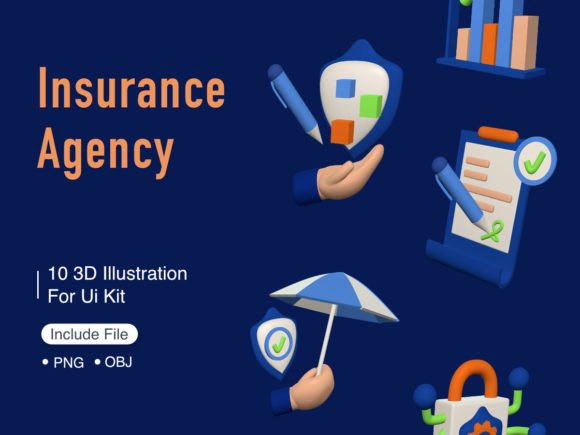
Insurance Agency 3D Illustration: Transforming Trust into Visual Impact
In an industry built entirely on trust, clarity, and the promise of security, traditional marketing materials often fall short. Insurance is inherently abstract; it involves complex policies, future scenarios, and invisible safety nets. How do you visually represent a cyber insurance policy or explain the nuances of an accident coverage audit to a client in a way that feels immediate and understandable? This is where Insurance Agency 3D Illustration emerges as a transformative tool. It moves beyond static graphics to create immersive, three-dimensional environments that bring the intangible world of risk management to life.
For modern agencies, adopting this visual strategy is not merely about aesthetics; it is a strategic necessity for cutting through the noise. Whether you are a seasoned broker looking to revamp your brand or a new startup aiming to establish credibility, integrating high-quality 3D visuals into your workflow can fundamentally change how clients perceive your services.
Bridging the Gap Between Abstract Concepts and Client Understanding
The primary challenge facing the insurance sector today is communication complexity. Clients often struggle to differentiate between various types of coverage, such as cyber insurance versus general liability, or they may feel overwhelmed by the jargon surrounding an insurance audit. Traditional flat illustrations or stock photography often fail to convey depth or specific details, leaving potential clients confused or disengaged.
Insurance Agency 3D Illustration solves this problem by providing a tangible representation of abstract concepts. By rendering insurance documents, agents, and assets in three dimensions, you create a sense of realism that flat images cannot match. For instance, a 3D illustration can depict a secure digital firewall protecting a home network, effectively visualizing what a cyber insurance policy actually does. This visual translation helps clients grasp the value proposition instantly, reducing friction in the sales process and fostering a deeper understanding of their needs.
Strategic Applications Across Your Business Ecosystem
The versatility of 3D imagery allows it to be deployed seamlessly across every touchpoint of your agency's ecosystem. Unlike static assets that lose impact when resized, 3D models maintain their quality and integrity regardless of the medium. This adaptability makes Insurance Agency 3D Illustration the perfect way to market your business consistently from digital screens to physical print.
- Digital Presence: On your website, dynamic 3D elements can guide users through complex flows, such as selecting a coverage plan or initiating a claim. Interactive 3D scenes can showcase an insurance agent helping a family, creating an emotional connection before the user even speaks to a representative.
- Print Marketing: In brochures and flyers, 3D illustrations add a tactile premium feel. They draw the eye immediately, distinguishing your literature from competitors who rely on generic photos. A brochure detailing insurance billing services becomes more engaging when accompanied by a 3D render of organized financial records and secure data locks.
- Business Cards: In a sea of standard cards, a design featuring a subtle yet sophisticated 3D element can make your contact information memorable. It signals innovation and attention to detail, qualities that clients highly value in an insurance analyst or agent.
Enhancing Specific Service Offerings with Visual Precision
Different areas of the insurance industry require distinct visual narratives. A one-size-fits-all approach rarely works when explaining specialized services. Insurance Agency 3D Illustration offers the flexibility to tailor visuals to specific niches, ensuring that the message resonates with the target audience.
Consider the role of an insurance agent handling accident insurance. A 3D scene can illustrate the moment of recovery, showing a vehicle being repaired or a medical facility, emphasizing the support system in place. For insurance service corp professionals managing large-scale insurance audits, 3D graphics can visualize data streams and compliance checklists, making the audit process appear transparent and manageable rather than intimidating.
Similarly, for cyber insurance, which deals with invisible threats, 3D art can personify digital risks. Imagine a stylized, colorful 3D representation of a hacker attempting to breach a shielded server, with the insurance policy acting as the barrier. This visualization demystifies the threat landscape and positions your agency as a proactive guardian. When discussing insurance billing and insurance documents, 3D renders can highlight organization, security seals, and the ease of access, reinforcing the reliability of your administrative processes.
Addressing the Needs of Diverse User Groups
Not all stakeholders approach insurance marketing with the same goals. Your strategy must account for the varying perspectives of clients, internal teams, and partners.
For clients, the goal is reassurance. They need to feel safe and informed. Insurance Agency 3D Illustration provides a friendly, approachable entry point into serious topics. It reduces anxiety by presenting solutions in a clean, modern, and non-threatening manner. The visual language becomes a bridge, turning a daunting conversation about premiums and deductibles into an accessible dialogue.
For internal teams, including insurance analysts, these visuals serve as powerful training tools. Complex scenarios involving multiple layers of coverage can be modeled in 3D, allowing new hires to visualize case studies and understand the interplay between different policy clauses. This accelerates onboarding and ensures that the entire team speaks with a unified, professional voice.
Partners and corporate clients look for stability and innovation. When pitching to a corporation for a large-scale insurance audit or comprehensive coverage plan, presenting a portfolio rich with 3D illustrations demonstrates technical competence and a forward-thinking mindset. It shows that your agency invests in modern technology to better serve its partners.
Implementation and Practical Considerations
Integrating Insurance Agency 3D Illustration into your workflow requires thoughtful planning. The key is to focus on usefulness over mere decoration. Every image should serve a purpose, whether it is to explain a policy feature, build brand identity, or simplify a complex concept.
When working with designers or agencies, prioritize clarity. Avoid overly cluttered scenes that distract from the core message. Instead, opt for clean compositions that highlight the relationship between the client, the agent, and the protection provided. Color palettes should align with your brand identity while evoking feelings of trust and security—blues, greens, and warm neutrals often work well in this context.
Furthermore, consider the lifecycle of your content. High-quality 3D assets are reusable. A model created for a website banner can be repurposed for a social media post, a presentation slide, or a printed brochure. This scalability maximizes your return on investment and ensures a cohesive brand presence across all channels.
Conclusion: A Visual Investment in Your Future
The insurance industry is evolving, and so must its marketing strategies. In a competitive market, standing out requires more than just a good price point; it demands a compelling narrative. Insurance Agency 3D Illustration provides the canvas for that narrative, transforming dry facts into engaging stories and abstract policies into visible realities.
By leveraging these visuals, you empower your insurance agents to communicate more effectively, assist your insurance analysts in simplifying complex data, and ultimately provide your clients with a clearer path to peace of mind. Whether used on your website, in detailed brochures, or on your daily business cards, 3D illustration proves itself as the perfect way to market your business. It is an investment in clarity, trust, and the future growth of your agency.